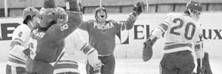

🇺🇸 United States 9-4 Czechoslovakia 🇨🇿
Olympic Medal Round
Blyth Memorial Ice Arena, Olympic Valley 🇺🇸
Sunday, 28 February 1960
The Americans had no time to celebrate (their previous day’s victory over the Soviet Union) because they were scheduled to be on the ice at eight the next morning to face the Czechs for the Gold medal.
Organizers expected the Canada–Soviet Union game to be for the Gold, so the USA-Czech game was scheduled for early Sunday.
The Americans had defeated the Czechs 7-5 in pool play, but they were made uneasy because they had been forced to come from behind to do it. There was no denying they were facing a well-schooled team, quite capable of rendering their victories over Canada and the Soviet Union relatively meaningless.
As if to add some drama to the script, the Americans fell behind 4-3 after two periods. After watching this, Soviet team captain Nikolai Sologubov decided to make a visit to the Americans’ dressing room, thereby creating a legend of Olympic competition. He couldn’t speak English, and his message was lost until he began using charade like hand gestures.
“When he put his hand over his mouth we realized he was trying to convince us to take oxygen,” Bill Cleary said.
Sologubov believed the oxygen would re-energize the Americans at the high altitude of the Olympic Valley, which was a mile above sea level.
When the Americans scored six goals in the third period to upend the Czechs, the media proclaimed Sologubov a true sportsman and saluted his noble gesture as one of the keys to the victory.
But years later, most of the American players weren’t so sure how much it really helped the team. Only eight players took the oxygen. “All I know is Roger Christian didn’t take oxygen, and he scored three goals in the third period,” McCartan said, laughing.
Some question whether Sologubov’s gesture was genuinely noble or just an attempt to assure that the archrival Czechs would not finish ahead of the Soviets. If the U.S. won, the Soviets would finish ahead of Czechoslovakia with the Bronze or Silver medal. On the other hand, “Solly,” as he was called by the U.S. players, was considered to be friendly toward the Americans.
“I played it up, because I knew it was a good story,” Riley recalled. “But it wasn’t a big thing in the dressing room.”
Bill Cleary, who had played against the Soviets on several occasions, tended to be more idealistic about Sologubov’s intentions. “We had played against them so often, I began to see them as friends,” Cleary said. “When they sat around and talked, they didn’t talk about communism. Like us, they talked about hockey and women.”
All the oxygen on mother earth wouldn’t have helped the Americans if McCartan hadn’t been as brilliant as he was during the tournament. He surrendered just 17 goals in seven games and was clearly the best goaltender in the tournament.
Ironically, McCartan had been cut from the roster three months earlier at the open tryouts. In November, he had tried out in Minneapolis and believed he had played well enough to make the team. When he went down to look at the “cut list” that had been posted by Riley, he whistled to himself over some of the names on the list.
“I thought they were cutting some pretty good guys, and then it hit me,” McCartan said. “These were the guys they were keeping, and my name wasn’t on the list.”
McCartan was devastated. Walter Bush, then general manager of St. Paul Steers senior team, called and stretched the truth to a U.S Army general that McCartan was needed as an emergency backup. He really just wanted McCartan for his team, which turned out to be fortunate because McCartan was in game shape when Riley called him a month later.
“That was my plan all along,” Riley insisted thirty-six years later. “He was in the army and I knew I could get him back. He was mad at me, and he played great. Hell, they were all mad at me.”
Members of the 1960 team say McCartan was the most valuable player of the tournament, although he prefers to modestly say the Americans’ success was a case of every player performing to the best of their ability.
Many players did play key roles in the triumph. Kirrane, a stay-at-home defenseman, had been the perfect complement for Mayasich. “He was black and blue from blocking shots,” Bill Cleary said. And the American players had been wrong about Bob Cleary, who was among the team’s top scorers. The controversy was forgotten, although the team photo with Bob Cleary’s head pasted over Herb Brooks’s body is a permanent reminder of the upheaval that was present heading into Olympic Valley. The Christian brothers were the first of the players to talk with the Clearys. “After it was all over, I remember us all standing in the shower and the Clearys thanking us for talking to them,” Roger said.
There were no invitations to the White House for this team, nor any notoriety that lasted beyond a week. With the NHL boasting only six teams, opportunities for U.S.-born players weren’t there.
BOXSCORE
1st Period
00:08 – 🇨🇿 GOAL – Vlach (Tikal, Golonka)
04:19 – 🇺🇸 GOAL – Olson (Johnson, Rodenheiser)
05:15 – 🇺🇸 PEN – Paavola, hooking
09:32 – 🇺🇸 GOAL – McVey (R. Cleary)
09:51 – 🇨🇿 PEN – Kasper, holding
11:11 – 🇨🇿 PEN – Tikal, holding
11:20 – 🇨🇿 SH2 GOAL – Bubník (Gut)
13:33 – 🇺🇸 GOAL – R. Christian (W. Christian, Williams)
14:40 – 🇨🇿 GOAL – Vaněk (Gut, Černý)
2nd Period
26:58 – 🇨🇿 GOAL – Vlach (Kasper)
30:26 – 🇨🇿 PEN – Černý, hooking
30:36 – 🇺🇸 PEN – Johnson, interference
39:25 – 🇺🇸 PEN – Kirrane, holding
3rd Period
45:59 – 🇺🇸 GOAL – R. Christian (W. Christian)
47:40 – 🇺🇸 GOAL – R. Cleary (Mayasich)
47:53 – 🇺🇸 PEN – McVey, holding + 10 min. misconduct
51:01 – 🇨🇿 PEN – Potsch, interference
51:36 – 🇺🇸 PP GOAL – R. Cleary (W. Cleary, Kirrane)
52:05 – 🇺🇸 PP GOAL – R. Christian (Mayasich, W. Cleary)
52:43 – 🇺🇸 PP GOAL – W. Cleary
57:56 – 🇺🇸 GOAL – R. Christian (W. Christian)
GOALTENDERS
W: 🇺🇸 McCartan (25-29), Palmer (1-1)
L: 🇨🇿 Nadrchal (45-54)
SHOTS ON GOAL
🇺🇸 17+9+28 = 54
🇨🇿 11+9+10 = 30
ROSTERS
🇺🇸 Goaltenders: Jack McCartan, Lawrence Palmer. Defence: William Christian, John Kirrane (C), John Mayasich, Edwyn Owen (A), Rodney Paavola. Forwards: Roger Christian, Robert Cleary, William Cleary, Paul Johnson, Robert McVey, Weldon Olson (A), Richard Rodenheiser, Tommy Williams.
🇨🇿 Goaltenders: Vladimír Dvořáček, Vladimír Nadrchal. Defence: Karel Gut, Jan Kasper, Rudolf Potsch, František Tikal. Forwards: Vlastimil Bubník, Josef Černý, Bronislav Danda, Jozef Golonka, Václav Pantůček, Ján Starší, František Vaněk, Miroslav Vlach, Jaroslav Volf.
| 🇺🇸 UNITED STATES (C) | vs. | CZECHOSLOVAKIA 🇨🇿 |
| current champion (since 27 Feb 1960) |
Last Title |
12 Nov 1959 |
| 16 | All-Time Wins |
7 |
| 2 wins | Head-To-Head |
1 win |
| First IHLC Meeting (USA vs. TCH) 🇨🇿 TCH 4-3 USA 🇺🇸 – 08 Feb 1948 – OG – St. Moritz 🇨🇭 |
||
| Previous IHLC Meeting (USA vs. TCH) 🇺🇸 USA 2-0 TCH 🇨🇿 – 19 Feb 1949 – WC – Stockholm 🇸🇪 |
||
| Last IHLC Game 🇺🇸 USA 3-2 URS 🇷🇺 – 27 Feb 1960 – OG – Olympic Valley 🇺🇸 |
||
| Next IHLC Game 🇺🇸 USA 2-2 FRG 🇩🇪 – 01 Feb 1961 – EX – Bad Tölz 🇩🇪 |
||
Article Credit: ESPN Classic
Photo Credit: NBC News – IIHF – HHOF – IOC
 International Hockey Lineal Championship